Monday, July 7, 2014

St. Louis, Springfield, and beyond

I spent most of Saturday in St. Louis as I had a few errands to run.  On the way out of town, I stopped at the beautiful Gateway Arch, also known as the Jefferson National Expansion Memorial.  Its outer covering is steel, and it's over 600 feet high.  At the base, I'm sure a football field would fit between the two footings.  The "legs" are about 50 feet wide at the bottom, but they narrow down to about 20 feet wide at the top.  I didn't ride the internal tram to the top or take a helicopter tour; those sorts of high adventures just didn't appeal to me that day.  The arch sits right by the Mississippi River with the city of St. Louis on the other side.  It symbolizes a gateway to the American West.  It's hard to imagine how big it is (or how hard it is to take a good picture of it) unless you visit.


I then traveled east back into Illinois.  I had crossed the northern part of this state, near Chicago, on the Lincoln Highway.  I spent Saturday night in Springfield, Illinois, the state capital.

Yesterday, I visited the Abraham Lincoln Home in Springfield.  His house and neighborhood have been restored, and you can tour the house where he lived before he went to Washington.  Some of the other houses have exhibits about the Lincolns and about archaeology and restoration.  It's a nice place to spend a couple of hours.


Then I traveled about 2 miles to the Lincoln Tomb state historic site.  It's in the Oak Ridge Cemetery, and it's very impressive.  All of the Lincolns are buried there, except for one son in Arlington National Cemetery.  There is a series of small statues of Lincoln at different stages of his career along the passageway inside the tomb that leads to the burial chamber.  Lincoln's monument is made of Arkansas granite and is a rust color.  He has flags around him representing states where he lived, states where his ancestors came from, and the presidential flag.


In Effingham, Illinois, there is a HUGE cross by the interstate highway.  It's called the "Cross at the Crossroads."  Christians in the area paid for it to be constructed as a ministry.  If you stop underneath it, there are 10 stations with recorded messages which represent the 10 Commandments.  I saw another one of these a few days ago in Texas, but the one in Effingham claims to be the biggest monument of this type.


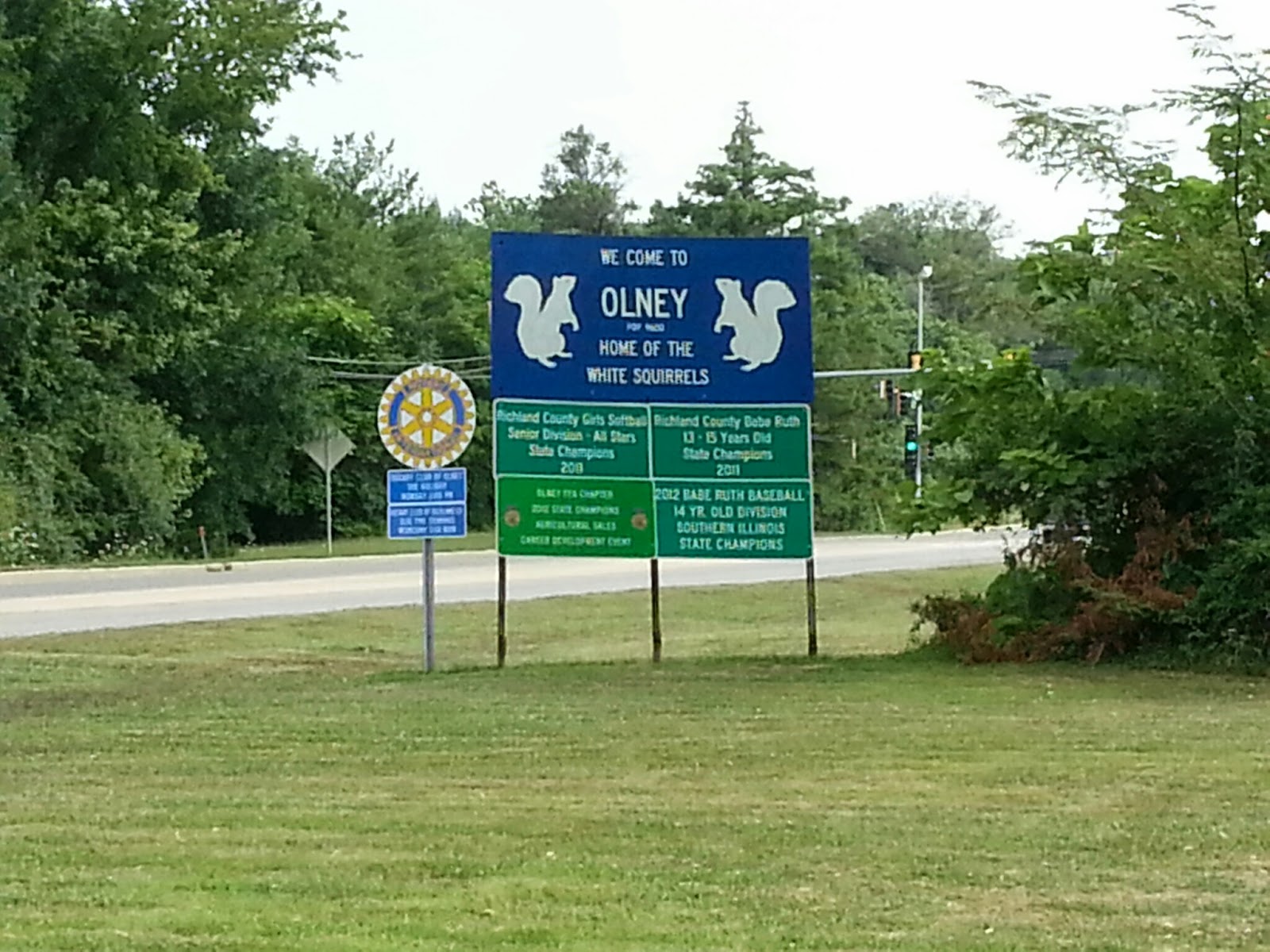


Before stopping in Evansville, Indiana, for the night, I made a quick detour to Olney, Illinois.  They are supposed to be the home of the "white squirrels."  They are seriously supposed to have albino squirrels living in the trees of their city park, but my wanderings in their park produced no sightings.  A minor disappointment in an otherwise tremendous vacation!


Saturday, July 5, 2014

George Washington Carver

My only sightseeing stop today was at the George Washington Carver National Monument.  This is in Diamond, Missouri, and is the location of his childhood home.  There is a nice museum, which includes a model of his classroom and lab at Tuskegee Institute.  They have a good film, which explains his accomplishments but helps you to understand his faith and motivation most of all.  Carver was the man who found so many uses for peanuts, sweet potatoes, and soybeans, and did pioneering exploration of plastics.  Finally, you can walk about a mile round trip to see the woods where he explored as a youth, the remnants of the farm where he grew up, and the plants he related to so well.  It was an out-of-the-way site that was well worth the time.


I crossed Missouri and got to St. Louis by nightfall.  There were several Independence Day fireworks displays visible from the hotel.


Friday, July 4, 2014

Three memorable places

Thursday's travels included the memorial at the Alfred P. Murrah Federal Building in Oklahoma City, the National Cowboy and Western Heritage Museum, and Oral Roberts University in Tulsa.  All were memorable.

The Oklahoma City bombing of 1995 was our biggest example of domestic terrorism.  Over 160 people were killed, and Timothy McVeigh was executed two years later for carrying out the bombing.  The memorial sits exactly where the building was located, and it has a museum next door.  There is a memorial to the children who died, a plaza with information on the south side, and a grove of trees in tribute to survivors and responders.  Two large walls with inscriptions block the street where the bombing occurred, which is now a reflecting pool.  There is a beautiful bronze and granite inscribed chair for each of the victims, arranged according to where they were located in the building.  On a nearby fence, people regularly leave tributes to the fallen.


I had always read that Oklahoma's state capitol building had oil wells on the grounds.  It is true!


Oklahoma City is also the home of the National Cowboy and Western Heritage Museum.  This is by far the largest, most comprehensive collection of art and memorabilia of the Old West way of life.  It includes a mock western town, indoor and outdoor sculptures, priceless works of art, Native American artifacts, and a cool exhibit of Western movie and TV stars.


This Lincoln statue was on display because the artist who produced the "End of the Trail" Indian statue in the rotunda of the museum produced it,  too.  Turns out that both were made for the two ends of the Lincoln Highway.  I guess these are the marble models, and the bronze statues are along the Highway.  I saw this Lincoln statue, in bronze, in Lincoln Park in Jersey City, NJ, three weeks ago.


Oral Roberts University in Tulsa seems like a great place for someone who is serious about a non-traditional, Christian college experience.  The whole campus is built around a prayer tower, which gives great views and offers a place for true contemplation.  The use of shiny gold colors and modern architectural forms gives the place a unique overall look.


After growing quite tired of Oklahoma's toll roads, I spent the night in Joplin, Missouri.