Wednesday, July 9, 2014

Shakers and Country Music

While still in Kentucky yesterday, I made my way to a village called South Union where the religious group known as the Shakers had a community from the early 1800s til about 1920.  They were celibate, strictly religious, hard working, and wanted to keep life simple and free of sin.  They utilized technology to the extent that it allowed them to make a good living in the world of their day, and they tried to leave peacefully with all people.  The Civil War caused their community great economic hardship from which it never really recovered.  The need to constantly recruit members became a problem as the frontier moved farther west and people saw greater adventure and fulfillment there.  They are credited with inventing the modern flat broom, and some of the furniture they built is considered priceless today.  There are six buildings open to the public, beautifully preserved and interpreted.


I drove to Nashville, Tennessee, to visit the Country Music Hall of Fame museum.  On the way, I stopped at a small community called Lutons to visit Grandpa Jones' gravesite.  I saw him on Hee Haw for many years, but I bought an album of his banjo music and mountain harmonies a few years ago and greatly enjoyed it.  It's a small Methodist church cemetery.


At the Hall in Nashville, what a joy to see all the stars I have enjoyed for so many years!  Their instruments, stage clothes, and other memorabilia are all over the place in the three-story modern museum, and the Hall of Fame Rotunda has the plaques with the names and likenesses of all of those who have been elected to the hall.  Whether you like old-time music like the Carter Family or the newest stuff from Taylor Swift and Jason Aldean, there's something for every music lover.


John Hartford's banjo.  The yellow pages
are his original copy of the lyrics of Glen
Campbell's "Gentle on my Mind"
Jim Reeves' red blazer

Bill Monroe's mandolin
Spent the night in Murfreesboro, Tennessee, the home of Middle Tennessee State University.

Tuesday, July 8, 2014

Indiana and Kentucky

On Monday, I toured the Toyota assembly plant in Princeton, Indiana.  Over 4700 people and a lot of robots put together Toyota Highlanders, Sequoias, and Sienna vans.  It was very educational and enjoyable.  They only allowed pictures in the visitors center.


Abraham Lincoln was born near Hodgenville, Kentucky.  The site has a neoclassical memorial building with a log cabin from the original site.  It's probably not the cabin in which he was born, but it comes from the same property in the same era.  A nearby spring was the reason his dad wanted this particular farm, and that is located right at the foot of the hill which houses the memorial.


I spent the night in Bowling Green, Kentucky.  The Lincoln birthplace was in the Eastern Time Zone, but Bowling Green is Central.  I'm right on the line here, but I think I'll be in Central Time for one more day.

Monday, July 7, 2014

St. Louis, Springfield, and beyond

I spent most of Saturday in St. Louis as I had a few errands to run.  On the way out of town, I stopped at the beautiful Gateway Arch, also known as the Jefferson National Expansion Memorial.  Its outer covering is steel, and it's over 600 feet high.  At the base, I'm sure a football field would fit between the two footings.  The "legs" are about 50 feet wide at the bottom, but they narrow down to about 20 feet wide at the top.  I didn't ride the internal tram to the top or take a helicopter tour; those sorts of high adventures just didn't appeal to me that day.  The arch sits right by the Mississippi River with the city of St. Louis on the other side.  It symbolizes a gateway to the American West.  It's hard to imagine how big it is (or how hard it is to take a good picture of it) unless you visit.


I then traveled east back into Illinois.  I had crossed the northern part of this state, near Chicago, on the Lincoln Highway.  I spent Saturday night in Springfield, Illinois, the state capital.

Yesterday, I visited the Abraham Lincoln Home in Springfield.  His house and neighborhood have been restored, and you can tour the house where he lived before he went to Washington.  Some of the other houses have exhibits about the Lincolns and about archaeology and restoration.  It's a nice place to spend a couple of hours.


Then I traveled about 2 miles to the Lincoln Tomb state historic site.  It's in the Oak Ridge Cemetery, and it's very impressive.  All of the Lincolns are buried there, except for one son in Arlington National Cemetery.  There is a series of small statues of Lincoln at different stages of his career along the passageway inside the tomb that leads to the burial chamber.  Lincoln's monument is made of Arkansas granite and is a rust color.  He has flags around him representing states where he lived, states where his ancestors came from, and the presidential flag.


In Effingham, Illinois, there is a HUGE cross by the interstate highway.  It's called the "Cross at the Crossroads."  Christians in the area paid for it to be constructed as a ministry.  If you stop underneath it, there are 10 stations with recorded messages which represent the 10 Commandments.  I saw another one of these a few days ago in Texas, but the one in Effingham claims to be the biggest monument of this type.


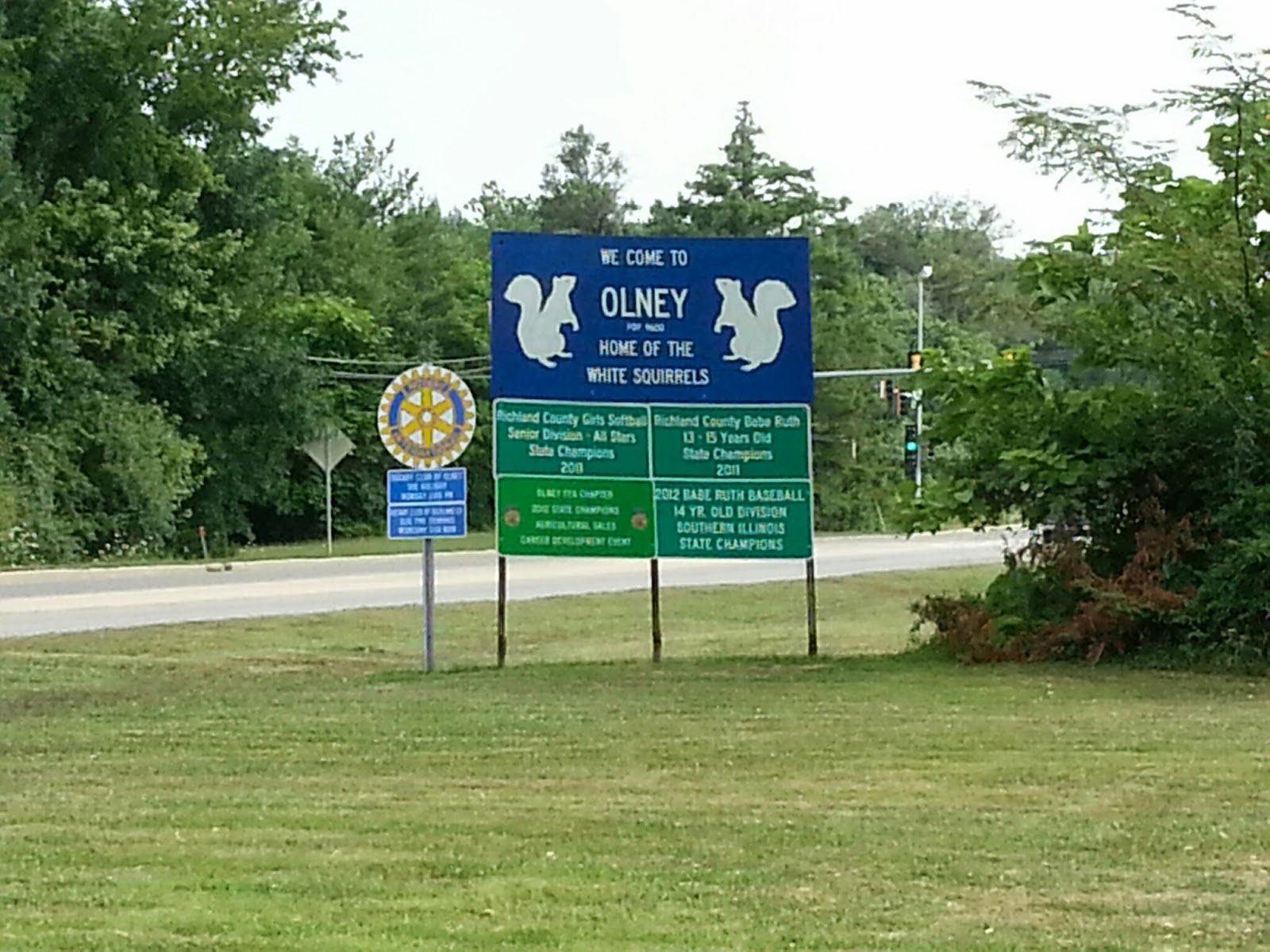
Before stopping in Evansville, Indiana, for the night, I made a quick detour to Olney, Illinois.  They are supposed to be the home of the "white squirrels."  They are seriously supposed to have albino squirrels living in the trees of their city park, but my wanderings in their park produced no sightings.  A minor disappointment in an otherwise tremendous vacation!